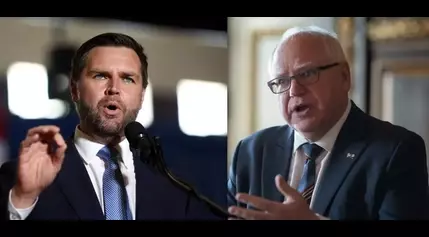
Walz's Modest Finances Contrast with Vance's Wealth
Minnesota Governor Tim Walz, the Democrats' recently selected vice-presidential nominee, stands out for his modest financial portfolio, which is a stark contrast to the wealth of his Republican counterpart, Senator JD Vance of Ohio. Walz's financial disclosure form reveals a relatively simple financial picture, with no businesses, individual stocks, or real estate holdings to his name. This stands in stark contrast to the financial complexities often associated with national political candidates.A Financially Unassuming Candidate
A Straightforward Financial Landscape
Walz's financial disclosure form for the state of Minnesota is remarkably sparse, listing only his government salary and his wife's income from her work in education. The couple's combined income for 2022 was a little over 6,000, with Walz's annual salary as governor amounting to 5,485. This modest financial position is a far cry from the wealth often associated with high-profile political candidates.
A Shift from Homeownership to the Governor's Residence
After becoming governor in 2019, Walz and his wife sold their home in Mankato, Minnesota, and moved into the Minnesota Governor's Residence in St. Paul. They are currently residing in the University of Minnesota president's house while the governor's residence undergoes renovations. This transition from private homeownership to living in state-provided residences further underscores Walz's relatively simple financial circumstances.
A Stark Contrast to Vance's Wealth
Walz's modest financial portfolio stands in stark contrast to the wealth of his Republican counterpart, Senator JD Vance. Vance, who hails from Ohio, has a more complex financial background, with a range of business interests and investments. This difference in financial standing between the two vice-presidential candidates highlights the diverse backgrounds and experiences that can shape a candidate's path to national office.
A Historically Modest Candidate
Walz's financial position is not entirely unprecedented among vice-presidential candidates. Hubert Humphrey, who served as vice president under Lyndon B. Johnson in the 1960s, was also not a wealthy man, having previously worked as a college professor and radio commentator. In contrast, Dick Cheney, who served as vice president under George W. Bush, had an estimated net worth of well over million when he took office, having previously served as the CEO of energy giant Halliburton.
Unique Perspectives and Experiences
Walz's financial background, while modest, may provide him with a unique perspective and understanding of the challenges faced by many Americans. His experience as a former high school teacher and his relatively straightforward financial situation could resonate with voters who are seeking candidates who can relate to their own financial realities. This contrast with the wealth of some past and present candidates may also shape the narrative and discourse surrounding the upcoming election.